
Lactic vs glycolic vs mandelic acid for sensitive skin
Three alpha hydroxy acids at three speeds: glycolic is the smallest and fastest, lactic also hydrates, mandelic is the largest and slowest, which is why reactive skin often starts there.
Lactic acid (ingredient page) Glycolic acid Mandelic acid
Criterion by criterion.
Swipe sideways to see every column.
| Criterion | Lactic acid Ingredient page | Glycolic acid | Mandelic acid |
|---|---|---|---|
| Molecule size 4 | About 90 g/mol | About 76 g/mol; the smallest AHA | About 152 g/mol; the largest of the three |
| Penetration and speed 1 | Moderate; slower than glycolic | Fastest; acts quickest and is the most likely to sting | Slowest and most even; more oil-soluble than the other two |
| Extra properties | Humectant; part of the skin's natural moisturising factor | The most studied AHA for texture and tone | Aromatic AHA derived from bitter almond; fewer published studies |
| Irritation potential | Low to moderate | Highest of the three at equal percentage and pH | Lowest of the three; widely described as the gentlest AHA |
| Typical leave-on range | 5–10% | 5–10%; start lower on sensitive skin | 5–10% |
| Sun sensitivity 2 | Increases UV sensitivity while in use; daily SPF required | Increases UV sensitivity while in use; daily SPF required | Increases UV sensitivity while in use; daily SPF required |
| Safety assessments (to our understanding) | CIR (1998): safe in consumer products at up to 10%, pH 3.5 or above, with sun-protection directions | CIR (1998): safe in consumer products at up to 10%, pH 3.5 or above, with sun-protection directions | Not part of the 1998 CIR AHA assessment; listed in CosIng with no EU concentration limit we are aware of |
Lactic, glycolic and mandelic acid are all alpha hydroxy acids (AHAs). Each loosens the bonds between dead surface cells so they shed more evenly, which is what makes skin look smoother and brighter after a few weeks of use. For sensitive skin the differences that matter come down to molecule size, how quickly each acid moves into the skin, and what else it does while it is there.
Glycolic acid is the smallest of the three, at about 76 g/mol, so it penetrates fastest and works quickest. That speed is also why it is the most likely to sting, flush or over-exfoliate reactive skin, especially at higher percentages or lower pH.
Lactic acid is a little larger, about 90 g/mol, and moves more slowly. It is also a natural component of the skin’s own moisturising system, and at low concentrations it behaves as a humectant as well as an exfoliant. For dry, sensitive skin that still wants gentle resurfacing, that dual role is useful.
Mandelic acid is the largest, about 152 g/mol, and more oil-soluble than the other two. It penetrates slowly and evenly, which spreads its action out and lowers the chance of a sudden irritation response. It is widely described as the gentlest of the three for this reason, though it has far fewer published studies behind it than glycolic acid.
All three increase the skin’s sensitivity to UV while in use. Daily broad-spectrum sunscreen is not optional with any of them, and a patch test before the first full application is sensible for anyone who reacts easily.
Who should choose which.
Choose glycolic acid if your skin is resilient, you want the fastest visible change in texture, and you can build up from a low percentage. Start at 5% or less, two or three evenings a week, before going daily.
Choose lactic acid if your skin is dry as well as sensitive, or if glycolic acid has left it tight. It exfoliates more gently and adds moisture rather than taking it away.
Choose mandelic acid if your skin is reactive, redness-prone, or has a deeper tone that darkens easily after irritation. Its slow, even action is the most forgiving of the three, and it is a reasonable first AHA for anyone who has never used one.
None of the three is right for everyone. Whichever you pick, the percentage, the pH of the formula and how often you use it matter more than the name of the acid.
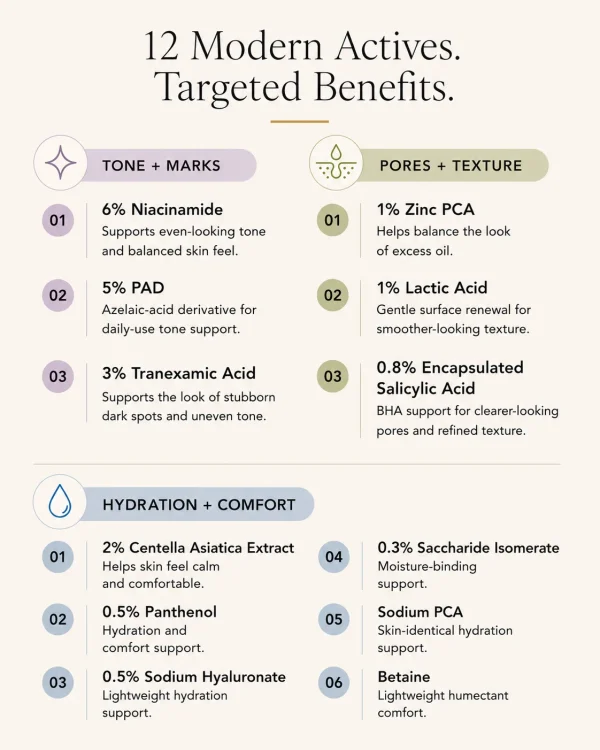
In our formulas Our Multi-Active Complex Face Serum includes lactic acid.
Questions, answered.
Can I use two of these acids together?
You can, but there is little reason to on sensitive skin. Layering acids raises the total exfoliation without improving the result. Pick one, use it at the frequency your skin tolerates, and reassess after four to six weeks.
Does a lower pH make an AHA work better?
Yes, and it also makes it harsher. More of the acid is in its active, uncharged form at low pH. Consumer leave-on products usually sit between pH 3.5 and 4.5 to balance effect and tolerance.
Do I need sunscreen if I only use the acid at night?
Yes. The increase in UV sensitivity lasts beyond the evening you apply it. Use a broad-spectrum sunscreen every morning for as long as you are using any AHA.
References
- Tang SC, Yang JH. Dual effects of alpha-hydroxy acids on the skin. Molecules. 2018;23(4):863. ncbi.nlm.nih.gov/pmc/articles/PMC6017965/ · DOI: 10.3390/molecules23040863
- Kornhauser A, Coelho SG, Hearing VJ. Applications of hydroxy acids: classification, mechanisms, and photoactivity. Clin Cosmet Investig Dermatol. 2010;3:135–142. ncbi.nlm.nih.gov/pmc/articles/PMC3047947/ · DOI: 10.2147/CCID.S9042
- Cosmetic Ingredient Review Expert Panel. Final report on the safety assessment of glycolic acid, lactic acid, their salts and esters. Int J Toxicol. 1998;17(Suppl 1):1–241.
- PubChem compound summaries: glycolic acid (CID 757), lactic acid (CID 612), mandelic acid (CID 1292). National Library of Medicine. pubchem.ncbi.nlm.nih.gov/compound/757
From The Constant.
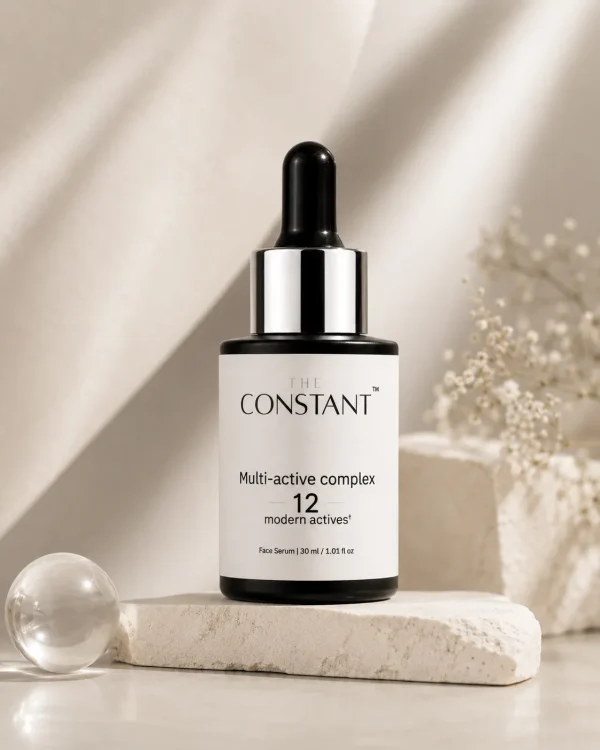
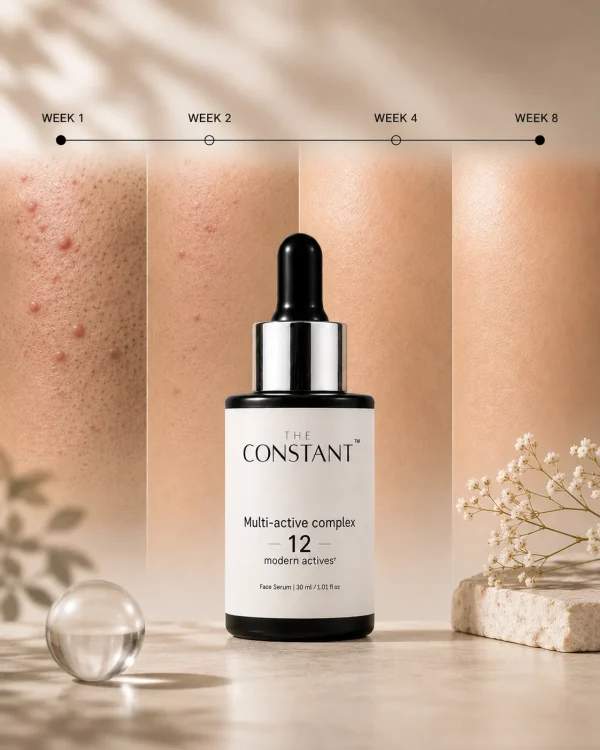
Multi-Active Complex Face Serum
12 modern actives. One lightweight daily serum for dark spots, pigmentation, acne marks, uneven tone, pores and texture, with 6% Niacinamide, 5% Potassium Azeloyl Diglycinate (PAD), 3% Tranexamic Acid, BHA/AHA and barrier-supporting hydrators.
More comparisons.
Niacinamide vs vitamin C for uneven tone
Niacinamide · Vitamin C
Niacinamide slows pigment transfer and is stable and forgiving. Vitamin C acts on the pigment-making enzyme and adds antioxidant support, but pure L-ascorbic acid is fussy. Many routines use both.
Updated 16 September 2026
Tranexamic acid vs kojic acid
Tranexamic acid · Kojic acid
Tranexamic acid calms the signals that switch pigment cells on and is stable at 2–5%. Kojic acid blocks the pigment enzyme directly but oxidises in the bottle and can sensitise, so the EU caps it at 1%.
Updated 16 September 2026
Potassium azeloyl diglycinate vs azelaic acid
Potassium azeloyl diglycinate · Azelaic acid
Azelaic acid has decades of evidence, mostly at 15–20% medicine strengths that can sting. Potassium azeloyl diglycinate is its water-soluble, glycine-linked cousin: gentler, easier to formulate, far less studied.
Updated 16 September 2026