
Tranexamic acid vs kojic acid
Tranexamic acid calms the signals that switch pigment cells on and is stable at 2–5%. Kojic acid blocks the pigment enzyme directly but oxidises in the bottle and can sensitise, so the EU caps it at 1%.
Tranexamic acid (ingredient page) Kojic acid
Criterion by criterion.
Swipe sideways to see every column.
| Criterion | Tranexamic acid Ingredient page | Kojic acid |
|---|---|---|
| What it is 4 | Synthetic lysine derivative; water-soluble; colourless | Fermentation-derived pyranone; water-soluble; browns on oxidation |
| Where it acts | Upstream: reduces plasmin-driven signals that raise pigment output after UV or irritation | Direct: binds copper at the active site of tyrosinase, the pigment-making enzyme |
| Typical cosmetic use level | 2–5% | Up to 1% (EU limit); higher levels historically, with more sensitisation reported |
| Stability in formula | Stable across normal pH; no special packaging needed | Oxidises and discolours; light-sensitive; needs opaque, airless packaging or the dipalmitate ester |
| Tolerability | Generally well tolerated; occasional dryness or mild irritation | Recognised contact sensitiser; irritation and allergic reactions reported, rising with concentration and duration |
| Regulatory status (to our understanding) | EU: not restricted in the Cosmetics Regulation annexes. India: no specific limit we are aware of. Japan: approved quasi-drug active | EU: SCCS considers 1% in face and hand creams safe; a 1% Annex III limit was added in 2024. India: no specific limit we are aware of |
| Evidence base | Growing; most topical studies are small, 8–12 weeks, at 2–5% | Long history of use; strong in-vitro enzyme data, fewer controlled consumer studies |
Both ingredients are used for a more even-looking tone, but they act at different points in the pigment pathway and behave very differently in a formula.
Tranexamic acid is a synthetic derivative of the amino acid lysine. In skin it reduces plasmin activity in surface cells after UV exposure or irritation. Plasmin is one of the signals that tells pigment cells to increase output, so damping it lowers the trigger rather than blocking the enzyme. It is water-soluble, stable across normal formulation pH, colourless, and has a good tolerability record in the topical studies published so far, which typically use 2–5% over 8–12 weeks. Occasional dryness or mild irritation is the most common complaint. In Japan it is an approved quasi-drug active for tone concerns.
Kojic acid is produced by fermentation, historically by the moulds used to make sake and soy sauce. It inhibits tyrosinase, the copper-dependent enzyme that produces pigment, by binding the copper at its active site. That direct action is why it has a long history in tone products. Its weaknesses are practical: it oxidises readily and browns in the bottle, it is light-sensitive, and it is a recognised contact sensitiser, with irritation and allergic reactions reported more often as concentration and duration increase. Kojic dipalmitate, a more stable ester, is often used instead, though whether it converts back to kojic acid in skin is not well established.
Regulation reflects that record. The EU’s Scientific Committee on Consumer Safety concluded that 1% kojic acid in face and hand creams is safe, and, to our understanding, a 2024 amendment to the Cosmetics Regulation added a 1% limit to Annex III. We are not aware of a specific concentration limit for either ingredient in India, where both are used in cosmetics, and tranexamic acid is not restricted in the EU annexes as far as we know. Rules change; check the current text before relying on this.
Who should choose which.
Choose tranexamic acid if your uneven tone flares after sun exposure or after irritation, if your skin is sensitive, or if you want an ingredient that layers easily with niacinamide, vitamin C derivatives and gentle acids. It is the lower-drama option and the one with the better stability record.
Choose kojic acid if you want a direct tyrosinase inhibitor, you tolerate it well on a patch test, and you are buying a product in airless, opaque packaging that you will finish within a few months. Stay at or below 1%, and stop if you notice redness, itching or a rash.
Neither works quickly. Plan on 8–12 weeks of daily use alongside sunscreen before judging either one, and expect the sunscreen to do at least half the work.
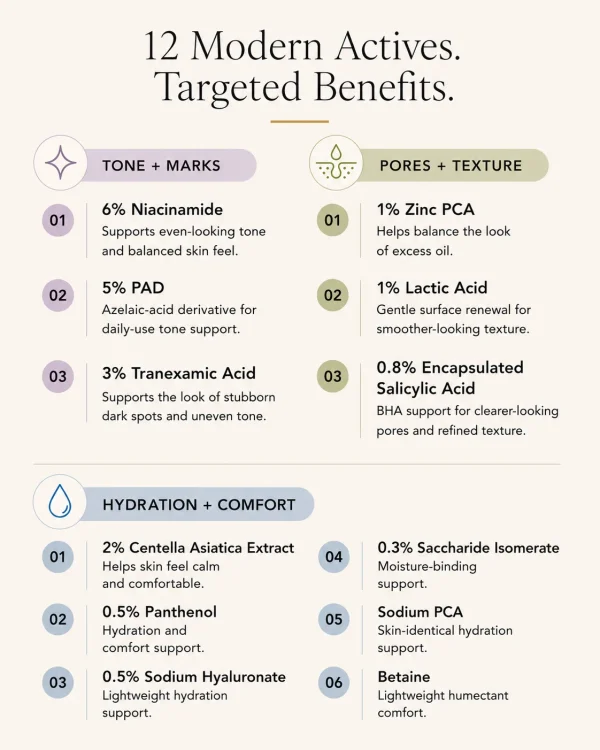
In our formulas Our Multi-Active Complex Face Serum includes tranexamic acid (3.0%).
Questions, answered.
Is tranexamic acid in skincare the same as the medicine?
It is the same molecule. As a medicine it is taken orally or by injection to reduce bleeding. In skincare it is applied to the skin at 2–5%, where the purpose is cosmetic and the amount is a small fraction of an oral dose. Do not take the oral form for skin without medical advice.
Why do kojic acid products change colour?
Kojic acid oxidises when exposed to air and light. The brown tint means some of the active has degraded. Choose airless, opaque packaging, keep the cap tight, and replace the product once it darkens noticeably.
Can I use both together?
There is no known chemical conflict, but stacking two tone actives on sensitive skin raises the chance of irritation without a clear gain. If you want two mechanisms, tranexamic acid with niacinamide is the gentler pairing.
References
- Maeda K, Naganuma M. Topical trans-4-aminomethylcyclohexanecarboxylic acid prevents ultraviolet radiation-induced pigmentation. J Photochem Photobiol B. 1998;47(2–3):136–141.
- Scientific Committee on Consumer Safety (SCCS). Opinion on kojic acid. SCCS/1481/12, 2012.
- Saeedi M, Eslamifar M, Khezri K. Kojic acid applications in cosmetic and pharmaceutical preparations. Biomed Pharmacother. 2019;110:582–593. · DOI: 10.1016/j.biopha.2018.12.006
- PubChem compound summaries: tranexamic acid (CID 5526), kojic acid (CID 3840). National Library of Medicine. pubchem.ncbi.nlm.nih.gov/compound/5526
From The Constant.
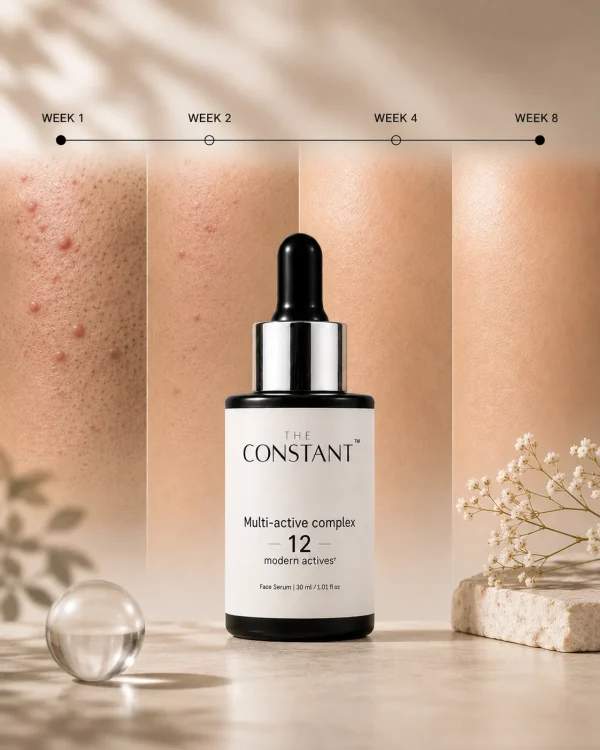
Multi-Active Complex Face Serum
12 modern actives. One lightweight daily serum for dark spots, pigmentation, acne marks, uneven tone, pores and texture, with 6% Niacinamide, 5% Potassium Azeloyl Diglycinate (PAD), 3% Tranexamic Acid, BHA/AHA and barrier-supporting hydrators.
More comparisons.
Lactic vs glycolic vs mandelic acid for sensitive skin
Lactic acid · Glycolic acid · Mandelic acid
Three alpha hydroxy acids at three speeds: glycolic is the smallest and fastest, lactic also hydrates, mandelic is the largest and slowest, which is why reactive skin often starts there.
Updated 16 September 2026
Niacinamide vs vitamin C for uneven tone
Niacinamide · Vitamin C
Niacinamide slows pigment transfer and is stable and forgiving. Vitamin C acts on the pigment-making enzyme and adds antioxidant support, but pure L-ascorbic acid is fussy. Many routines use both.
Updated 16 September 2026
Potassium azeloyl diglycinate vs azelaic acid
Potassium azeloyl diglycinate · Azelaic acid
Azelaic acid has decades of evidence, mostly at 15–20% medicine strengths that can sting. Potassium azeloyl diglycinate is its water-soluble, glycine-linked cousin: gentler, easier to formulate, far less studied.
Updated 16 September 2026