
Potassium azeloyl diglycinate vs azelaic acid
Azelaic acid has decades of evidence, mostly at 15–20% medicine strengths that can sting. Potassium azeloyl diglycinate is its water-soluble, glycine-linked cousin: gentler, easier to formulate, far less studied.
Potassium azeloyl diglycinate (ingredient page) Azelaic acid
Criterion by criterion.
Swipe sideways to see every column.
| Criterion | Potassium azeloyl diglycinate Ingredient page | Azelaic acid |
|---|---|---|
| What it is 3 | Azelaic acid conjugated with two glycine molecules, as a potassium salt; water-soluble | Naturally occurring C9 dicarboxylic acid; poorly water-soluble |
| Typical cosmetic use level | 3–5%, occasionally up to 10% | Up to 10% in cosmetics; 15–20% products are medicines in many markets |
| Formulation and texture | Water phase; mild pH; clear, light serums and gels | Needs high loading in creams or gels; heavier, sometimes grainy textures |
| Tolerability | Reported as well tolerated in supplier and small in-vivo studies | Transient stinging, burning and tingling are common at 15–20%, usually easing over weeks |
| Evidence base | Small: supplier data, in-vitro work, a few small studies | Large: decades of controlled studies, mostly at 15–20% |
| Mechanism, cosmetic view | Carries the azelaic moiety; sebum-balancing and tone-evening claims rest mainly on supplier data | Competitive tyrosinase inhibition; antioxidant; calming for red-looking skin |
| Regulatory notes (to our understanding) 2 | Listed in CosIng as a cosmetic ingredient; no concentration limit we are aware of in the EU or India | Permitted in cosmetics at typical levels of 10% or less in the EU and India; higher strengths are sold as medicines |
Azelaic acid is a nine-carbon dicarboxylic acid found naturally in grains such as wheat, rye and barley. It has one of the longest evidence records of any tone-and-clarity active: a competitive inhibitor of tyrosinase, an antioxidant, and a calming ingredient for skin that looks red or congested. The catch is physical. Azelaic acid dissolves poorly in water and has to be loaded at high percentages to work, which is why the well-studied products are 15–20% creams and gels regulated as medicines in many markets, including India, and why those products are known for stinging, burning and tingling in the first weeks. Cosmetic formulas usually stop at 10%, and even there the texture tends to be heavy or slightly grainy.
Potassium azeloyl diglycinate is azelaic acid joined to two molecules of glycine and neutralised as a potassium salt. The change makes it water-soluble, so it can go into the water phase of a light serum or gel at a mild pH, with no grain and no heavy oil phase. Suppliers position it at 3–5% for sebum balance, moisturisation and a more even-looking tone, and describe it as better tolerated than azelaic acid itself. That is plausible from the chemistry, since the acid is masked and the concentration is lower, but the published evidence is thin: mostly supplier data, in-vitro work and small in-vivo studies, not the controlled trials that exist for azelaic acid.
The honest summary is that the two sit at opposite ends of an evidence-versus-elegance trade-off. One is well proven, awkward to formulate and often uncomfortable at the strengths that were studied. The other is comfortable and easy to use but has not yet been tested to the same standard.
Who should choose which.
Choose azelaic acid if you want the ingredient with the deepest evidence base and can tolerate a period of tingling, or if a medical professional has recommended a 15–20% product to you. At cosmetic strengths of around 10%, expect a heavier texture and a gentler, slower effect.
Choose potassium azeloyl diglycinate if your skin is sensitive or oily-combination, if you want a light serum you will actually use twice a day, or if azelaic acid has stung you before. Treat its benefits as promising rather than proven, and judge it on your own skin over 8–12 weeks.
Both can be used alongside niacinamide and sunscreen. Neither replaces sun protection, which remains the single most effective step towards an even-looking tone.
In our formulas Our Multi-Active Complex Face Serum includes potassium azeloyl diglycinate (5.0%).
Questions, answered.
Is potassium azeloyl diglycinate just diluted azelaic acid?
No. It is a different molecule: azelaic acid bonded to two glycine units and neutralised as a salt. That is what makes it water-soluble and milder. Whether skin converts it back to free azelaic acid, and how much, has not been well characterised in published work.
Why does azelaic acid sting?
At 15–20% a great deal of acid sits on the skin at once. For most people the sensation fades within two to four weeks of regular use. Applying to fully dry skin, starting once a day and following with a plain moisturiser all help.
Can I use either with niacinamide?
Yes. Neither has a known conflict with niacinamide, and the two are often formulated together. Introduce one new active at a time so you can tell what your skin is responding to.
References
- Sieber MA, Hegel JKE. Azelaic acid: properties and mode of action. Skin Pharmacol Physiol. 2014;27(Suppl 1):9–17. · DOI: 10.1159/000354888
- European Commission, CosIng (Cosmetic Ingredient Database): entries for Potassium Azeloyl Diglycinate and Azelaic Acid. ec.europa.eu/growth/tools-databases/cosing/
- PubChem compound summary: azelaic acid (CID 2266). National Library of Medicine. pubchem.ncbi.nlm.nih.gov/compound/2266
From The Constant.
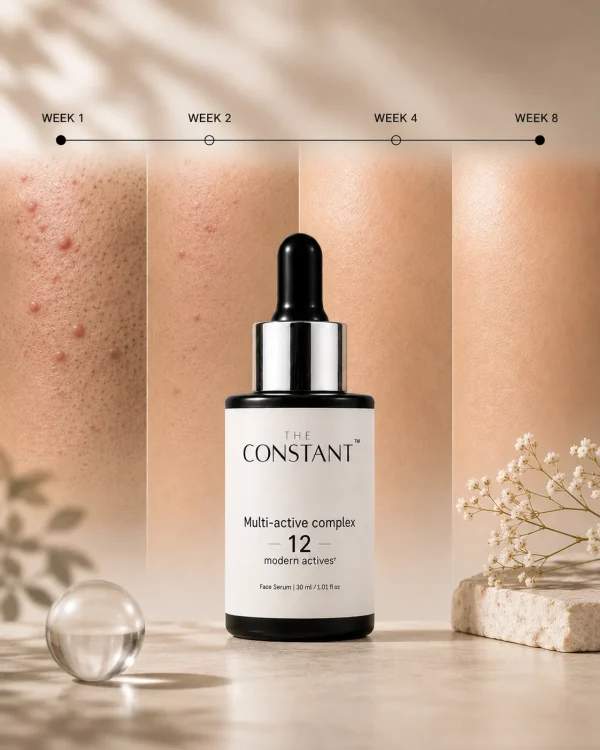
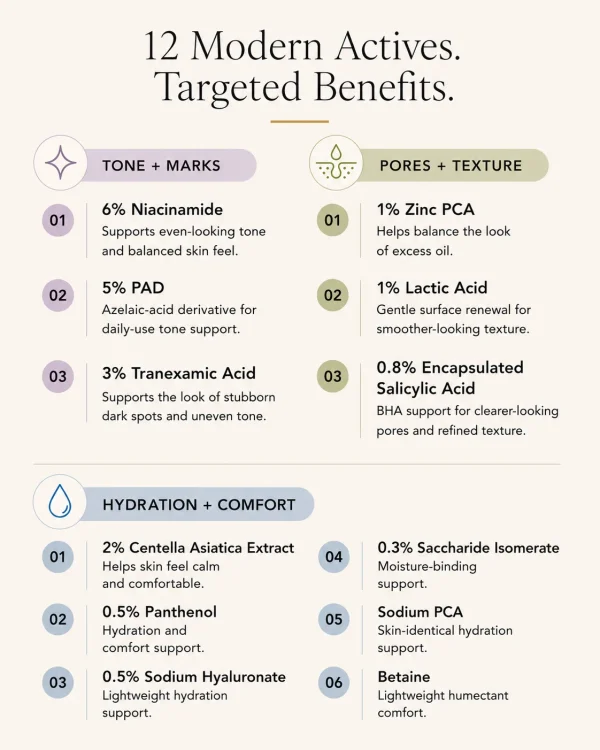
Multi-Active Complex Face Serum
12 modern actives. One lightweight daily serum for dark spots, pigmentation, acne marks, uneven tone, pores and texture, with 6% Niacinamide, 5% Potassium Azeloyl Diglycinate (PAD), 3% Tranexamic Acid, BHA/AHA and barrier-supporting hydrators.
More comparisons.
Lactic vs glycolic vs mandelic acid for sensitive skin
Lactic acid · Glycolic acid · Mandelic acid
Three alpha hydroxy acids at three speeds: glycolic is the smallest and fastest, lactic also hydrates, mandelic is the largest and slowest, which is why reactive skin often starts there.
Updated 16 September 2026
Niacinamide vs vitamin C for uneven tone
Niacinamide · Vitamin C
Niacinamide slows pigment transfer and is stable and forgiving. Vitamin C acts on the pigment-making enzyme and adds antioxidant support, but pure L-ascorbic acid is fussy. Many routines use both.
Updated 16 September 2026
Tranexamic acid vs kojic acid
Tranexamic acid · Kojic acid
Tranexamic acid calms the signals that switch pigment cells on and is stable at 2–5%. Kojic acid blocks the pigment enzyme directly but oxidises in the bottle and can sensitise, so the EU caps it at 1%.
Updated 16 September 2026