
Modern UV filters vs legacy filters
Tinosorb S, Tinosorb M and Uvinul A Plus are photostable, cover UVB through long UVA and barely penetrate skin. The legacy trio are US-approved but need stabilising or carry absorption and regulatory concerns.
Modern filters (Tinosorb S, Tinosorb M, Uvinul A Plus) Legacy filters (avobenzone, oxybenzone, octinoxate)
Criterion by criterion.
Swipe sideways to see every column.
| Criterion | Modern filters (Tinosorb S, Tinosorb M, Uvinul A Plus) | Legacy filters (avobenzone, oxybenzone, octinoxate) |
|---|---|---|
| Spectrum covered | UVB through UVA1. Tinosorb S and M are broad-spectrum in one molecule; Uvinul A Plus is a dedicated UVA1 filter (peak about 354 nm) | Avobenzone: UVA1, needs stabilising. Oxybenzone: UVB and short UVA. Octinoxate: UVB only |
| Photostability | All three photostable; Tinosorb S also stabilises avobenzone | Avobenzone degrades in sunlight unless stabilised; octinoxate accelerates that breakdown; oxybenzone relatively stable |
| Skin absorption 2 | Very low measured penetration; Tinosorb S and M are large molecules (over 600 daltons) | Oxybenzone, avobenzone and octinoxate were each measured in blood above the FDA's 0.5 ng/mL threshold in the 2020 maximal-use trial |
| Sensory and texture | Efficient, so a lower total filter load for SPF 50+ and PA++++; Tinosorb M can add a faint white cast at high levels | Octinoxate is a light liquid; avobenzone systems need extra stabilisers, adding load; oxybenzone is a frequent photoallergen among filters |
| EU limits (Annex VI) 3 | 10% each | Avobenzone 5%; octinoxate 10%; oxybenzone 6% in face products and 2.2% in body products since 2022 |
| US and India status (to our understanding) | US: not yet approved. India: permitted; IS 4707 (Part 2) broadly follows the EU list | US: monograph-approved (avobenzone 3%, oxybenzone 6%, octinoxate 7.5%). India: permitted |
| Environmental notes | Limited data; no sales bans we are aware of | Oxybenzone and octinoxate banned from sale in Hawaii since 2021 over reef concerns; similar rules in some other jurisdictions |
Sunscreen filters fall into two generations. The legacy organic filters, avobenzone, oxybenzone and octinoxate, were approved in the United States decades ago. The newer filters, bemotrizinol (Tinosorb S), bisoctrizole (Tinosorb M) and diethylamino hydroxybenzoyl hexyl benzoate (Uvinul A Plus), came out of Europe from the late 1990s. They are permitted in the EU, Australia, Japan and, to our understanding, India, but had not been approved in the US as of our last review.
The differences are physical. Avobenzone, the main legacy UVA filter, is not photostable on its own: it loses a meaningful share of its absorbance in sunlight unless stabilised, and octinoxate accelerates that breakdown. Oxybenzone covers UVB and short UVA but is one of the more frequent photoallergens among filters, and in FDA-run maximal-use trials published in JAMA in 2019 and 2020 it was measured in blood well above the agency’s 0.5 ng/mL safety-testing threshold. Oxybenzone and octinoxate have also been banned from sale in Hawaii since 2021 over coral reef concerns.
The modern filters were designed around those problems. All three are photostable. Tinosorb S and Tinosorb M cover UVB through UVA1 in a single molecule; Uvinul A Plus is a stable, dedicated UVA1 filter peaking around 354 nm. Tinosorb S and M are large molecules, over 600 daltons, and measured skin penetration for all three is very low. Tinosorb M, a micro-fine particle dispersion, also scatters and reflects, which helps efficiency but can leave a faint cast at high levels. Efficient, stable filters reach SPF 50+ and PA++++ with a lower total load, which is usually why a modern-filter sunscreen feels lighter.
Regulation shapes availability. The EU permits each modern filter at up to 10% and lowered the oxybenzone limit in 2022. The US approves the legacy three under its monograph and none of the modern three. India’s list of permitted UV filters broadly follows the EU annex, so both generations are sold here. The table carries the figures as we understand them; rules change, so check current annexes before relying on them.
Who should choose which.
Choose a modern-filter sunscreen if you want deep UVA1 protection in a comfortable texture, if you are outdoors for hours and need protection that lasts, if your skin has reacted to oxybenzone, or if you prefer filters with very low measured skin absorption. In India these are readily available.
Choose a legacy-filter sunscreen if you need a product that complies with the US monograph or if cost is the deciding factor. Look for avobenzone paired with a stabiliser, and avoid products that combine it with octinoxate.
Whichever you pick, the dose matters more than the filter list. Two finger-lengths for the face and neck, reapplied every two to three hours outdoors, is what the SPF number assumes.
In our formulas Our Silk Veil SPF 50+ PA++++ Sunscreen includes Tinosorb S, Tinosorb M and Uvinul A Plus.
Questions, answered.
Are modern filters allowed in India?
To our understanding, yes. India's IS 4707 (Part 2) list of permitted UV filters broadly follows the EU annex, and bemotrizinol, bisoctrizole and DHHB appear in sunscreens sold in India today. We are not regulators; check the current standard if it matters for a decision.
Is oxybenzone dangerous?
The evidence does not show harm from normal sunscreen use. What it shows is measurable absorption into the bloodstream above the FDA's threshold for further testing, and a higher rate of photoallergic reactions than most other filters. EU regulators responded by lowering permitted levels rather than banning it. Avoiding it is a reasonable preference, not a medical necessity.
Does chemical versus mineral matter more than modern versus legacy?
Less than the marketing suggests. Zinc oxide and titanium dioxide are stable and well tolerated but can be hard to formulate to high UVA ratings without a visible cast. Photostability, UVA1 coverage and whether you will wear enough of it are the questions that matter.
References
- Matta MK, Zusterzeel R, Pilli NR, et al. Effect of sunscreen application under maximal use conditions on plasma concentration of sunscreen active ingredients: a randomized clinical trial. JAMA. 2019;321(21):2082–2091. doi.org/10.1001/jama.2019.5586 · DOI: 10.1001/jama.2019.5586
- Matta MK, Florian J, Zusterzeel R, et al. Effect of sunscreen application on plasma concentration of sunscreen active ingredients: a randomized clinical trial. JAMA. 2020;323(3):256–267. doi.org/10.1001/jama.2019.20747 · DOI: 10.1001/jama.2019.20747
- Regulation (EC) No 1223/2009 of the European Parliament and of the Council on cosmetic products, Annex VI: list of UV filters allowed in cosmetic products (as amended). eur-lex.europa.eu/legal-content/EN/TXT/
- State of Hawaii, Act 104 (Senate Bill 2571, 2018): prohibition on the sale of sunscreens containing oxybenzone or octinoxate, effective 1 January 2021.
From The Constant.
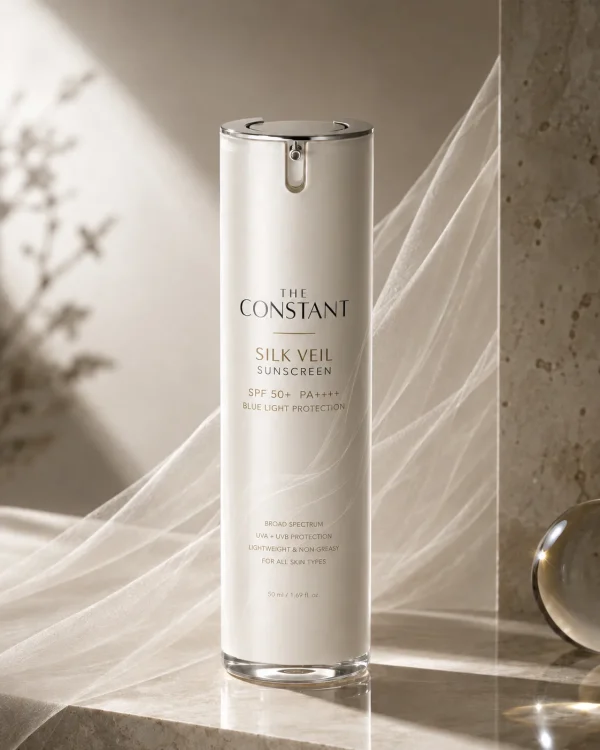
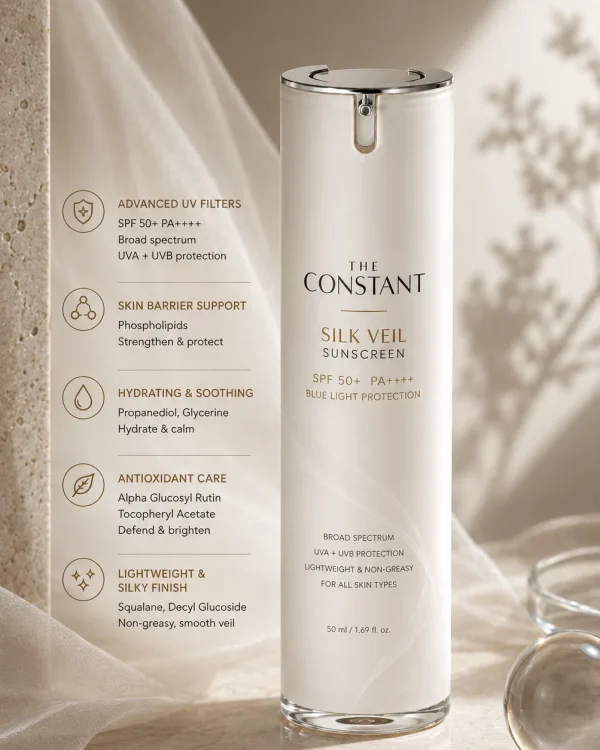
Silk Veil SPF 50+ PA++++ Sunscreen
A lightweight 50 ml daily face sunscreen with SPF 50+ PA++++ protection, powered by Uvinul A Plus, Uvinul T 150, Tinosorb S, Tinosorb M and Octisalate for broad UVA + UVB coverage, with hydration, antioxidant support and blue-light support.
More comparisons.
Lactic vs glycolic vs mandelic acid for sensitive skin
Lactic acid · Glycolic acid · Mandelic acid
Three alpha hydroxy acids at three speeds: glycolic is the smallest and fastest, lactic also hydrates, mandelic is the largest and slowest, which is why reactive skin often starts there.
Updated 16 September 2026
Niacinamide vs vitamin C for uneven tone
Niacinamide · Vitamin C
Niacinamide slows pigment transfer and is stable and forgiving. Vitamin C acts on the pigment-making enzyme and adds antioxidant support, but pure L-ascorbic acid is fussy. Many routines use both.
Updated 16 September 2026
Tranexamic acid vs kojic acid
Tranexamic acid · Kojic acid
Tranexamic acid calms the signals that switch pigment cells on and is stable at 2–5%. Kojic acid blocks the pigment enzyme directly but oxidises in the bottle and can sensitise, so the EU caps it at 1%.
Updated 16 September 2026