
Niacinamide vs vitamin C for uneven tone
Niacinamide slows pigment transfer and is stable and forgiving. Vitamin C acts on the pigment-making enzyme and adds antioxidant support, but pure L-ascorbic acid is fussy. Many routines use both.
Niacinamide (ingredient page) Vitamin C
Criterion by criterion.
Swipe sideways to see every column.
| Criterion | Niacinamide Ingredient page | Vitamin C |
|---|---|---|
| What it is | Vitamin B3 amide (nicotinamide); water-soluble; stable | L-ascorbic acid, or a derivative that converts to it in skin; water-soluble; oxidises readily |
| How it acts on tone 1 | Reduces melanosome transfer from pigment cells to surface cells | Interferes with tyrosinase at its copper site; reduces oxidised pigment intermediates; antioxidant |
| Studied concentrations 3 | 2–5% for tone; 10% common | L-ascorbic acid 10–20%; derivatives lower, with variable conversion |
| Formulation pH | About 5–7; forgiving | Below about 3.5 for L-ascorbic acid; derivatives near neutral |
| Stability and packaging | Stable to light, air and heat; ordinary packaging | L-ascorbic acid degrades with light, air and heat; opaque, airless packaging; often stabilised with ferulic acid and vitamin E |
| Tolerability | Well tolerated at 2–5%; some report flushing above about 10% | Low-pH L-ascorbic acid can sting, especially on sensitive skin; derivatives are gentler |
| Other effects 2 | Barrier support; helps the look of oil and pores | Antioxidant support under sunscreen; cofactor for collagen synthesis |
Niacinamide and vitamin C are the two most common actives for a more even-looking tone, and they reach that result by different routes. That matters, because it makes them complements more often than rivals.
Niacinamide is the amide form of vitamin B3. In skin it reduces the transfer of melanosomes, the packets of pigment, from the cells that make them to the surface cells where they become visible. A frequently cited 2002 study used 5%; most tone-focused formulas today sit between 2% and 5%, with 10% common but not clearly better for tone. It also supports the skin barrier and helps the look of oil and pores. It is water-soluble, stable to light and air, and comfortable at a skin-friendly pH, so very few formulation constraints apply.
Vitamin C, as L-ascorbic acid, works upstream. It interferes with tyrosinase, the copper-dependent enzyme that produces pigment, and it reduces oxidised pigment intermediates back to their colourless form. It is also an antioxidant that helps skin cope with the free radicals generated by UV and pollution, and a cofactor for collagen synthesis. The trade-off is chemistry. L-ascorbic acid oxidises quickly in water, needs a pH below about 3.5 to penetrate well, and is used at 10–20% in most studies. Low pH plus high concentration is what makes it sting on sensitive skin and turn yellow in the bottle. Derivatives such as sodium ascorbyl phosphate, ascorbyl glucoside and 3-O-ethyl ascorbic acid are gentler and more stable, but they must convert to ascorbic acid in the skin, and how completely they do so varies.
Neither ingredient increases sun sensitivity, so both can be used morning or evening, and both pair well with daily sunscreen.
Who should choose which.
Choose niacinamide if your skin is sensitive, oily or combination, if you want one ingredient that also helps the look of pores and barrier comfort, or if you have reacted to acidic vitamin C serums. It is the easier ingredient to live with and to formulate around.
Choose vitamin C if antioxidant support under sunscreen is part of the goal, if your skin tolerates low-pH products, and if you will use it consistently before it oxidises. Pick a stabilised L-ascorbic acid in opaque, airless packaging, or a derivative if you prefer comfort over peak potency.
Use both if you want the two mechanisms working together. The often-repeated caution about combining them is not borne out by how modern formulas are used. If you notice flushing, apply them at different times of day.
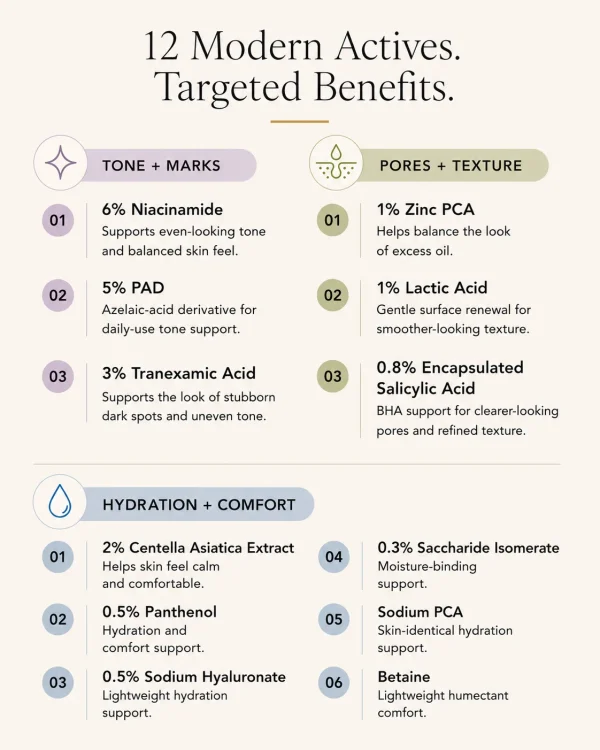
In our formulas Our Multi-Active Complex Face Serum includes niacinamide (6.0%).
Questions, answered.
Can I use niacinamide and vitamin C in the same routine?
Yes. They work by different mechanisms and are routinely formulated together. If you use a low-pH L-ascorbic acid serum, apply it first, wait a minute, then apply niacinamide. If you notice flushing, move one to the evening.
Which works faster on uneven tone?
Neither is quick. Most studies of either ingredient run 8–12 weeks before measuring a change. Expect a gradual, cumulative shift rather than a visible difference in the first fortnight.
Why did my vitamin C serum turn orange?
The L-ascorbic acid has oxidised. The colour change means less active ingredient remains. Store it cool and dark, keep the cap on, and replace it once it darkens.
References
- Boo YC. Mechanistic basis and clinical evidence for the applications of nicotinamide (niacinamide) to control skin aging and pigmentation. Antioxidants (Basel). 2021;10(8):1315. ncbi.nlm.nih.gov/pmc/articles/PMC8389214/ · DOI: 10.3390/antiox10081315
- Pullar JM, Carr AC, Vissers MCM. The roles of vitamin C in skin health. Nutrients. 2017;9(8):866. ncbi.nlm.nih.gov/pmc/articles/PMC5579659/ · DOI: 10.3390/nu9080866
- Telang PS. Vitamin C in dermatology. Indian Dermatol Online J. 2013;4(2):143–146. ncbi.nlm.nih.gov/pmc/articles/PMC3673383/ · DOI: 10.4103/2229-5178.110593
From The Constant.
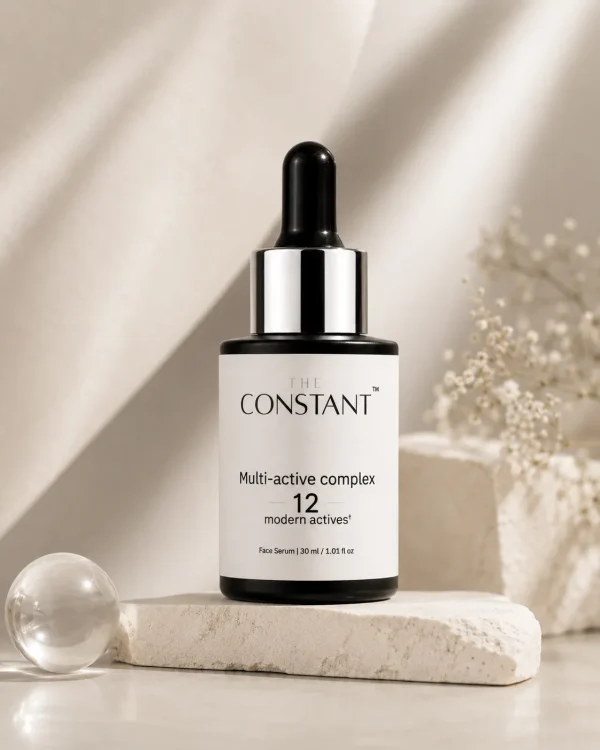
Multi-Active Complex Face Serum
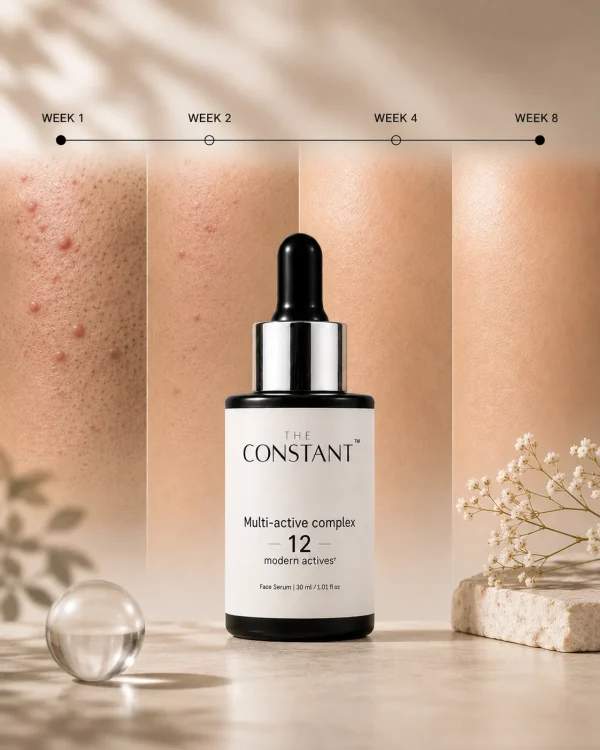
12 modern actives. One lightweight daily serum for dark spots, pigmentation, acne marks, uneven tone, pores and texture, with 6% Niacinamide, 5% Potassium Azeloyl Diglycinate (PAD), 3% Tranexamic Acid, BHA/AHA and barrier-supporting hydrators.
More comparisons.
Lactic vs glycolic vs mandelic acid for sensitive skin
Lactic acid · Glycolic acid · Mandelic acid
Three alpha hydroxy acids at three speeds: glycolic is the smallest and fastest, lactic also hydrates, mandelic is the largest and slowest, which is why reactive skin often starts there.
Updated 16 September 2026
Tranexamic acid vs kojic acid
Tranexamic acid · Kojic acid
Tranexamic acid calms the signals that switch pigment cells on and is stable at 2–5%. Kojic acid blocks the pigment enzyme directly but oxidises in the bottle and can sensitise, so the EU caps it at 1%.
Updated 16 September 2026
Potassium azeloyl diglycinate vs azelaic acid
Potassium azeloyl diglycinate · Azelaic acid
Azelaic acid has decades of evidence, mostly at 15–20% medicine strengths that can sting. Potassium azeloyl diglycinate is its water-soluble, glycine-linked cousin: gentler, easier to formulate, far less studied.
Updated 16 September 2026